Skip to Content

Turnkey Project Process: 

From Inquiry to Installation | RUN-TECH
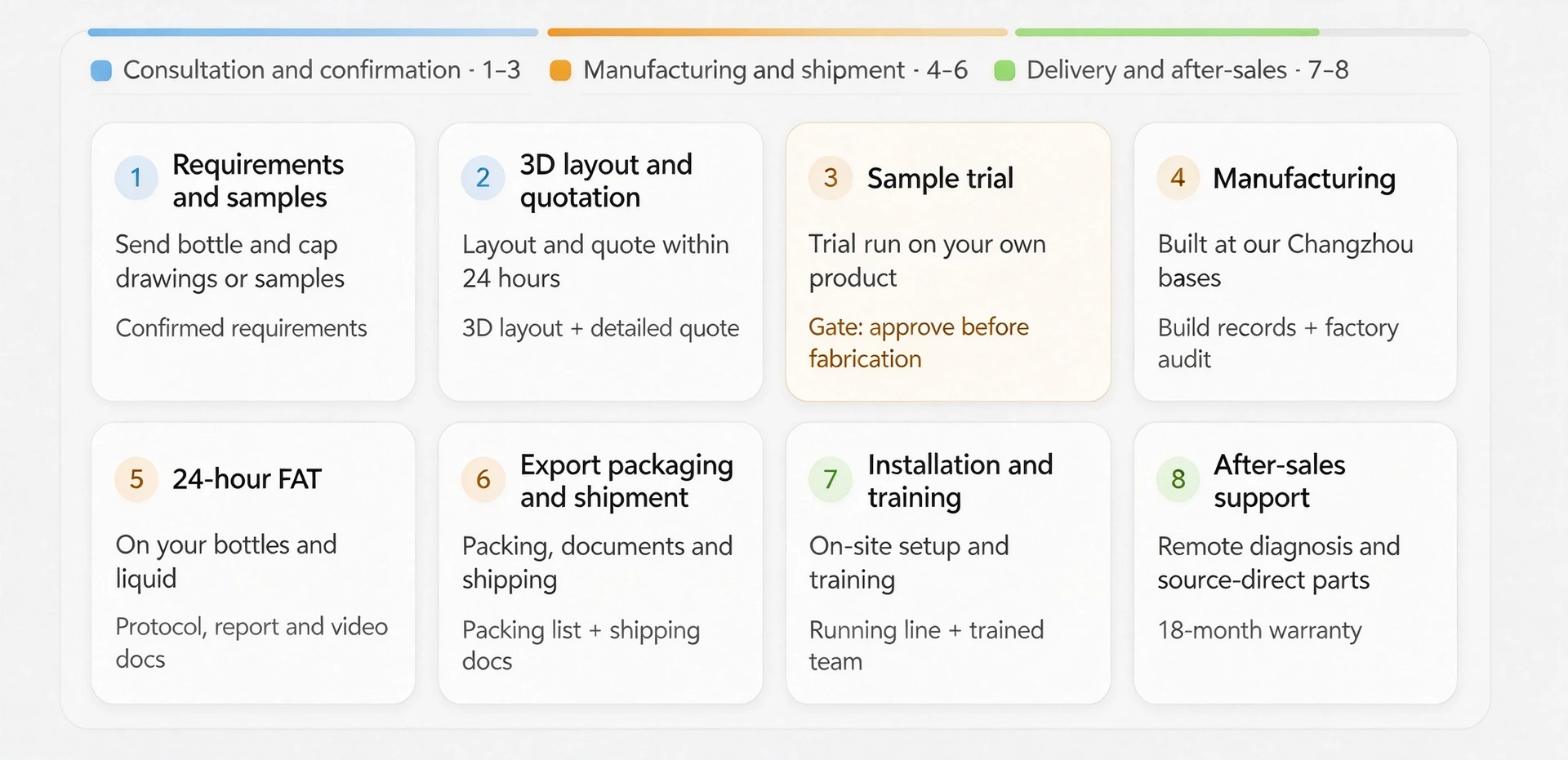
turnkey-project-process - equipment photo 1Here is the turnkey project process at RUN-TECH, from your first enquiry to the day your line runs: eight stages, each with a named deliverable and a clear action for you. Buyers who assemble a line from several vendors know the failure mode. Between machines nobody owns the seam, and a missed handoff becomes your production delay. Before 2025 our main market was domestic, with customers including Unilever, Nutrich, Rainbow, REDLION, BLUE MOON and SUPER, and machines sent overseas went through trading companies. Since the end of 2025 we have built the direct process below. This page opens the sequence so you can see what happens, what you receive and what you must prepare. Figures that depend on your site, your product or your destination are confirmed with the quotation once those details are known.
turnkey-project-process - equipment photo 2

1. The Eight Stages at a Glance

A turnkey packaging project runs through eight stages, each with a named deliverable and a clear action for the buyer. The sequence covers requirements, 3D layout and quotation, a sample trial, in-house manufacturing, a 24-hour FAT, export packaging, installation and training, and permanent after-sales support.

The table below is the short version; each stage then follows the same input, we do, you receive structure. Use it as a checklist when comparing suppliers, because a turnkey quotation is only as good as the handoffs behind it.

Stage

What you receive

Your action

1. Requirements and samples

Confirmed requirements checklist and a named technical contact

Send bottle and cap drawings or samples, product, target output, voltage and floor area

2. 3D layout and quotation

3D line layout and a detailed quotation within 24 hours

Confirm scope, model mix and floor plan

3. Sample trial

Video trial report on your own product and a compatibility analysis

Approve the configuration before any metal is cut

4. Manufacturing

Build records, material confirmation and access to a factory audit

Optional: audit the two Changzhou bases

5. FAT

FAT protocol, trial report and video, contact-material confirmation, final inspection record

Agree the acceptance criteria in advance

6. Export packaging and shipment

Packing list and shipping documents, wear-parts stock recommendation

Nominate the consignee and confirm destination documents

7. Installation and training

A running line, a trained operator team and the machine documents

Prepare site, utilities, access and people

8. After-sales

Remote fault diagnosis, source-direct spare parts, 18-month warranty cover

Report the fault with a description or grant remote access

Stage 3 gates stage 4: fabrication starts only after you approve the configuration that passed the trial. That keeps a project from drifting into an argument about whether the machine could ever run your product.

2. Stage 1: Requirements and Sample Submission

Input: your bottle and cap drawings or the physical parts, the product and its viscosity, the target output, the site voltage and the available floor area (see what to specify before buying a filling and capping machine for multiple bottle sizes if the line must handle more than one container).

What we do: we assign one responsible engineer and check the application boundaries before pricing. A low-pH drink and a solvent-based sanitiser do not get the same wetted parts, so the chemistry is settled here, not at commissioning.

What you receive: a confirmed requirements checklist and a named technical contact for the remaining stages.

The checklist records container dimensions, closure type, fill target, product behaviour and your site utilities; a buyer who fills it in removes most later surprises. If your product is corrosive or your closure is a pump head or trigger sprayer, send the actual component now. Those are the two cases where a catalogue assumption costs the most.

3. Stage 2: 3D Line Layout and Quotation Within 24 Hours

Input: the confirmed requirements and your floor plan.

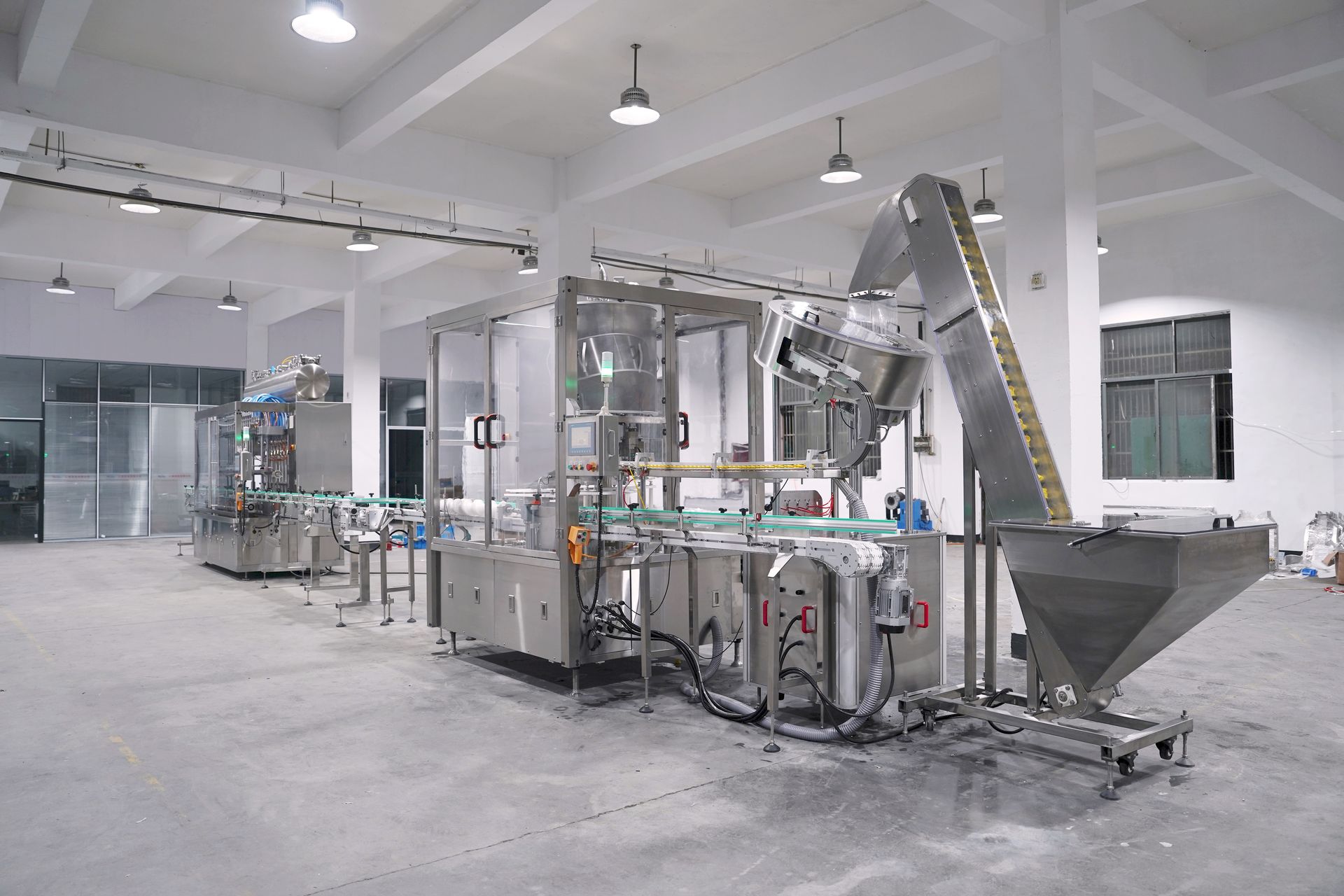
What we do: our engineers configure proven modules into a line, build a 3D model of the machines and a 3D layout of the line, then check conveyor transfers, operator reach, maintenance clearance and the distance between the filler and the capper on a real floor plan. We price that configuration, within 24 hours of receiving your requirements.

What you receive: the 3D layout and a detailed quotation, both in the same package.

The layout is the cheapest place to fix a bottleneck; on steel it is expensive. The modules configured here are our filling machines and capping machines.

4. Stage 3: Free Sample Trial and Compatibility Report

Input: your own bottles, caps and a small quantity of your product.

What we do: we run those samples on the proposed configuration, film the whole trial, and analyse three things: fill accuracy at your viscosity, how the cap seats, and whether the chosen contact materials behave with your formulation. The trial is free; you pay only the courier.

What you receive: a video trial report and a compatibility analysis, and a configuration that does not move into fabrication until you approve it.

This stage turns a drawing into evidence: you see your container on the machine. For the measured engineering behind that trial — accuracy, torque control and process capability — see how we fabricate and test the machines.

5. Stage 4: Building Your Line in Changzhou

Input: the approved configuration and the signed agreement.

What we do: SUS304 frames and SUS316L product-contact parts, with PTFE/PVDF for corrosive products, are fabricated at our own bases, then assembled, wired and programmed in Changzhou. The registered office is in Xinbei District, Changzhou City, Jiangsu Province. The first base in Wujin has run since 2021; a second base in Xinbei was newly built in 2026. As a turnkey packaging line supplier, we are the single accountable party for the line: filling, capping, labelling systems and downstream handling are integrated under one control scheme.

What you receive: build records and confirmation of the contact materials actually installed, plus access to see the work in person.

The team is 55 people, built around designers and chief engineers with more than 15 years in this field. Annual output is around 40–45 capping machines, excluding cappers integrated into filling lines. You can see our Changzhou bases during a factory audit; equipment lists, workshop footage, drawings and material certificates are shown there on request. Machine lists, brands, axis counts and machining tolerances are documented in person, against your machine. Industry 4.0 intelligent-plant work is shown during the audit.

6. Stage 5: 24-Hour FAT on Your Own Bottles and Liquid

Input: your sample bottles and your liquid, and the agreed fill target.

What we do: a 24-hour continuous FAT before shipment, running on your containers and your product so the result reflects your viscosity, container tolerance and closure. The acceptance criteria are fixed and binary: zero leakage and accurate dosing against the agreed target.

What you receive: the FAT protocol with those criteria agreed in advance, the trial report and video, confirmation of the contact materials installed, and the final inspection record against the 3D layout and configuration.

A full day of running exposes a seal that opens up only after the machine has warmed through; an early spot check would miss it. The configuration that passes is the one that ships, with the documents above. Acceptance thresholds sit in our FAT protocol and engineering tests; the test is defined before it starts and reported after it ends.

7. Stage 6: Export Packaging and Shipment

Input:  the FAT-passed machine and your destination-market documentation requirements.

What we do: we wrap the machine in moisture-proof film, pack it in export-standard wooden crates and prepare the shipping paperwork. Changzhou sits in the Yangtze River Delta with access to Shanghai and Ningbo ports, which gives your forwarder a straightforward collection point.

What you receive: the packing list and shipping documents, and a recommendation to stock a set of wear parts before dispatch.

That recommendation is practical: a crate opened at site is no use if a worn seal is missing, which is why wear parts are listed in the packing list. Container counts and transit days are confirmed with the quotation, since both depend on your destination, forwarder and shipping schedule. If your market needs specific import documents, raise that in stage 1 so it is reflected in the paperwork.

8. Stage 7: On-Site Installation, Commissioning and Direct Training

Input: a site with electricity, air and access ready, your operators, and the acceptance owner who will sign off the line.

What we do: we send technical staff to install and commission the line, then train your operators on the machine itself. The training is direct operation, on time and on site.

What you receive: a running line, a trained team and the machine documents that came with the configuration.

Installation days and the number of engineers on site depend on line scope and destination and are set out in the project agreement. What is fixed is the obligation: installation, commissioning, direct operation and training. Nominate one acceptance owner on your side before we travel; it shortens the handover.

9. Stage 8: Permanent After-Sales and Source-Direct Spare Parts

Input: a description of the fault, or remote access to the machine where your site rules allow it.

What we do: our engineers define the error point from your description or remote access. Program issues are resolved through our remote control function. Where a part is the cause, it comes directly from the source manufacturer, so the route is shorter and the cost lower than through an agent.

What you receive: a diagnosed fault, a resolution path, source-direct parts and 18-month warranty cover on the machine.

Support continues after the 18-month warranty ends. Because we fabricate and assemble in our own bases, the person who answers the call can trace a part back to the build record. That is the practical value of dealing with the factory, and why we recommend a wear-part set before shipping.

10. Certification and Documentation

turnkey-project-process - equipment photo 3

RUN-TECH holds ISO 9001:2015, ISO 45001:2018 and ISO 14001:2015 certification. Each covers a defined area: quality management, occupational health and safety, and environmental management respectively. The useful question for a regulated buyer is which document covers your configuration, so ask for the certificates applicable to your model and we will send them with the quotation.

On CE marking, we work machine by machine. A machine can be supplied with its own CE certificate, issued at the customer's request. Ownership belongs to the customer and we do not retain it; the document is made for your configuration and stays with you. The governing text is the EU Machinery Directive 2006/42/EC, which sets the essential requirements. Certificate numbers and issuing bodies are supplied with the quotation for your model.

11. Five Commitments We Put in Writing

Five items define the commercial side of this turnkey project process. All of them can go into the official agreement.

Commitment

What it means in practice

Quotation

Professional, detailed and competitive, with the configuration and documents identified

Installation and training

On time and on site: installation, commissioning, direct operation and training

After-sales service

Permanent and on time, with remote diagnosis and source-direct spare parts

Warranty

18 months on the machine

Lead time

Typically 15–30 days for a standard single machine and 30–45 days for a complete line

We keep this table short on purpose: a buyer needs terms they can hold a supplier to. Payment structure and milestones are agreed per project and set out in the contract.

12. What You Prepare, and What We Document

A turnkey project moves at the speed of its slowest input.

You prepare

We handle

Bottle and cap drawings or physical samples, plus a little product

3D layout, configuration and detailed quotation

Target output, product viscosity and chemistry

Sample trial, video report and compatibility analysis

Site utilities, floor area and access route

In-house fabrication, assembly, wiring and programming

Operators and one acceptance owner

FAT, export packaging and shipping documents

Destination-market documentation requirements

Installation, commissioning and direct operator training

Figures we keep off a public page — installation days, engineers on site, response-time commitments, certificate numbers and issuing bodies, workshop floor area, and the CNC machine list with brands, models, axis counts and machining tolerances — are confirmed per project and available for inspection at audit. None is secret; the equipment and inspection records can be seen there, and the applicable terms go into the agreement.

Let's Connect

Have your bottles and product ready? Send us your samples and we will run a trial on your own liquid, then return the video report and a 3D layout with quotation. Contact RUN-TECH to send samples and start your turnkey project — tell us your target output, voltage and floor area, and we will take it from there.